Your cart is empty

Can you trust AI for health information?
Guest article by Anuradha Wadhwani, Senior Digital Strategist, Reef Digital Agency
Hello, my name is Anu and I work in Search Optimisation. My job is to understand how information gets found online: which pages surface, why they surface, and what shapes the answer someone ends up reading. That makes the shift from traditional link-based search to AI-generated answers hard to ignore. Results on search engines like Google and Bing, among others, used to hand people a list of websites to choose between, but now increasingly it hands them a written answer instead.
For most everyday questions that works well. When it comes to your health, the stakes are significantly higher. That is why it pays to know what goes into generating an answer before taking action on it.
AI can help you make sense of medical language
Artificial intelligence can be useful when researching health topics. It can explain medical terminology in plain English, summarise a complex topic, and help you work out what to ask at your next appointment. If you’ve just been diagnosed with hepatitis B or hepatitis C and you’re reading words you’ve never come across before, that kind of help matters.
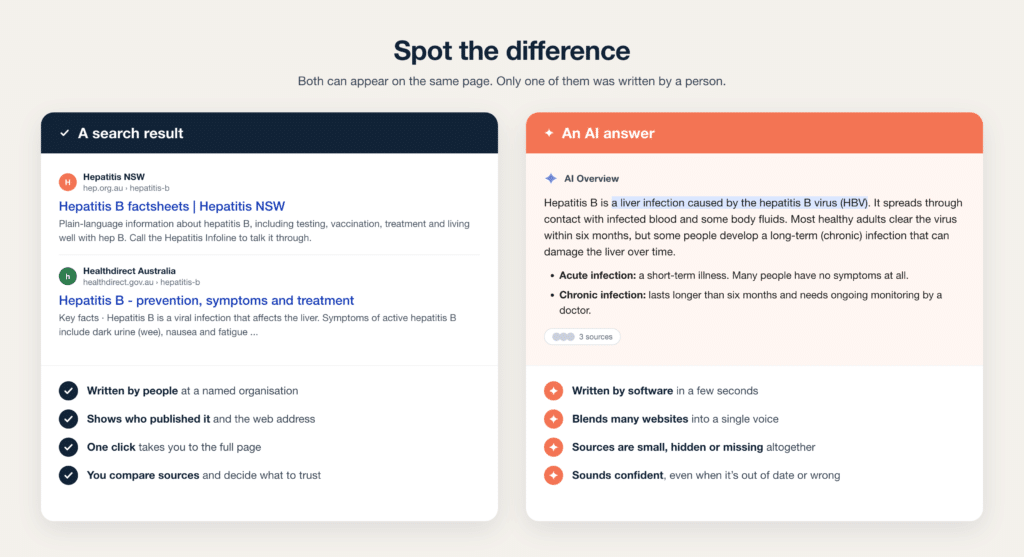
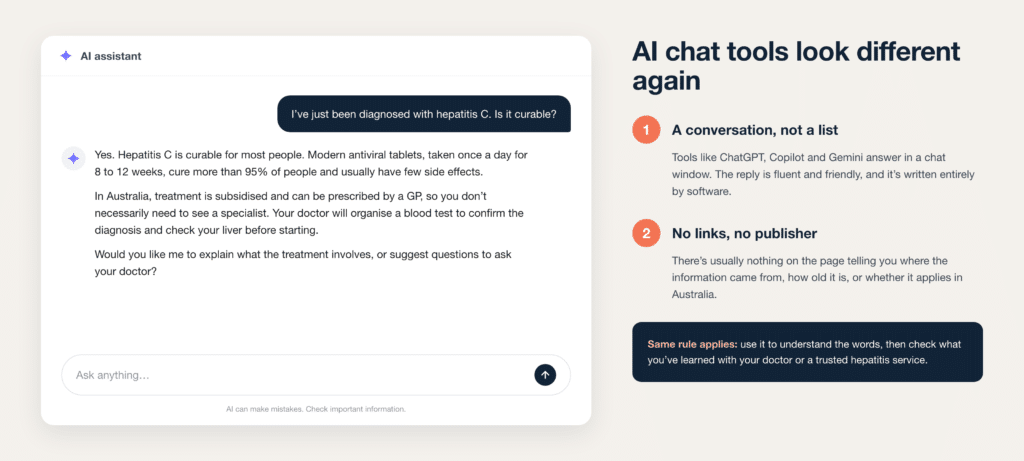
What makes it tricky is the way the answer is synthesised. It reads as clean, confident and finished, with no competing views on the page and often no visible sources, so you have very little to tell you how solid the ground underneath it is.
AI answers are assembled from what’s published online
An AI answer is built from material already on the web. Some of that material comes from health services, medical bodies and peer-reviewed research. Some of it comes from forums, marketing pages, personal blogs, social media content and content written for health systems in other countries. It all gets blended into a single response that reads with the same level of confidence.
A few things follow from that:
- Geographic and regional context matters. Testing pathways, treatment access and what’s subsidised under Medicare and the PBS work differently here to the US or the UK. An answer built on overseas sources can be accurate in its own context and still be wrong for you.
- The same question can produce different answers. Ask on a different day, or word your question slightly differently, and the response you get can change.
- Fluency says nothing about accuracy. A well-structured, confident-sounding answer can still be built on weak sources.
An AI response has no knowledge of your medical history, your test results, the medicines you’re already taking or your individual risk factors, and all of those change what the right answer is for you.
How to check where health information comes from
It’s good to ask where an answer came from before you rely on it. A few quick checks:
- Look for a named source. If the answer cites nothing, treat it as a lead to follow up.
- Check who publishes the underlying page. Government health services, established health organisations, universities and recognised medical bodies are what you want behind a health claim.
- Check that it applies in Australia. Mentions of Medicare, the PBS or state health services are a good signal, as are .gov.au and .org.au domains.
- Look for a named author or clinical reviewer on the source page.
- Cross-check anything that changes what you do. If an answer might affect whether you get tested, start treatment or change a medication, we always recommend confirming it with a health professional first.
- Check when the answer was published. Medical guidelines and recommendations change over time, so verify that the content is current
Where to find hepatitis information written for Australia
Hepatitis NSW publishes evidence-based information developed with input from Australian medical, research and public health experts, covering hep B testing, hep C testing, hep C treatment and liver health. The Hepatitis Infoline on 1800 803 990 connects you with someone who can talk through your situation and point you to services near you.
You can also follow Hepatitis NSW on Facebook, Instagram and YouTube, so reliable hepatitis information turns up in your feed alongside everything else.
When the question is about your own health, a conversation with a doctor or nurse gets you an answer that accounts for your circumstances. If you want to know whether you have hepatitis B, for example, a blood test is what confirms it, and your GP can arrange one.
Using AI as one part of how you find health information
AI will be increasingly integrated into how we search for health-related information, offering some advantages when used thoughtfully. It empowers you to gather background context and prepare the right questions for discussions with your medical provider. However, to use it safely, always verify any AI-generated advice against a trustworthy, accredited source prior to acting, because even a highly persuasive answer may not fit your specific medical needs.